
News
Inductance basics 1-why is the inductance when the ‘wire’ is wound into a ‘loop’? What is inductance?
- Author:Roger
- Release on:2021-01-13
The working principle of inductance is very abstract. In order to explain what an inductance is, we start with basic physical phenomena.
One, two phenomena and a law-magnetism by electricity, electricity by magnetism and Lenz's law
1. Electromagnetic phenomenon
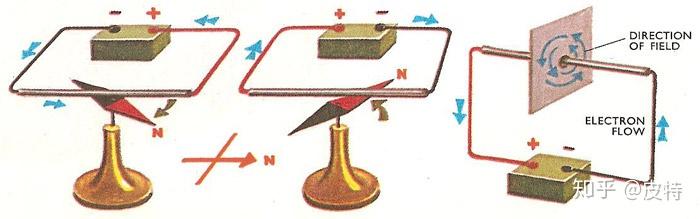
There was an experiment in high school physics: a small magnetic needle was placed next to the energized conductor, and the direction of the small magnetic needle was deflected, indicating that there is a magnetic field around the current. This phenomenon was discovered in 1820 by the Danish physicist Oersted.
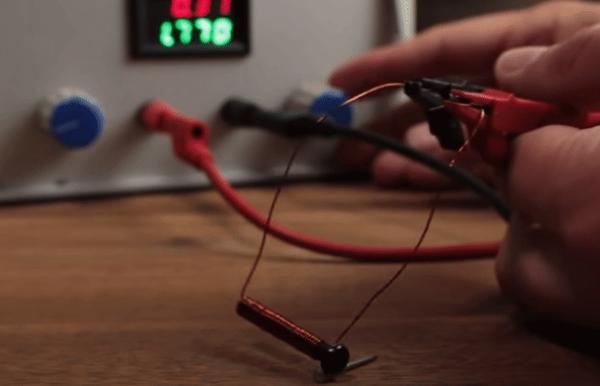
If we wind the conductor into a circle, the magnetic field generated by each circle of the conductor can be overlapped, and the overall magnetic field will become stronger, which can attract small objects. In the figure, the current of the coil is 2~3A. Note that the enameled wire has a rated current limit, otherwise it will melt at high temperature:
2. (Dynamic) Magnetism
In 1831, British scientist Faraday discovered that when a part of a conductor in a closed circuit performs a cutting magnetic field, electricity will be generated on the conductor. The prerequisite is that the circuit and the magnetic field are in a relatively changing environment, so it is called "moving" magnetism, and the generated current is called induced current.
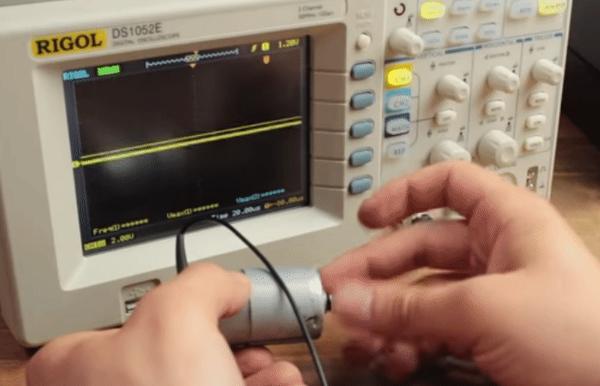
We can experiment with a motor. Generally, the common DC brush motor has permanent magnets in the stator and coil conductors in the rotor. Rotating the rotor manually means that the conductor is cutting the magnetic lines of force. Connect the two electrodes of the motor with an oscilloscope, and the voltage change can be measured. The generator is made based on this principle.
3. Lenz's Law
Lenz's law: The direction of the induced current generated by the change of the magnetic flux is the direction that opposes the change of the magnetic flux.
The simple understanding of this sentence is: when the magnetic field (external magnetic field) in the environment of the conductor becomes stronger, the magnetic field generated by its induced current is opposite to the effect of the external magnetic field, making the overall magnetic field weaker than the external magnetic field. When the magnetic field (external magnetic field) in the environment of the conductor becomes weaker, the magnetic field generated by its induced current is opposite to the effect of the external magnetic field, making the overall magnetic field stronger than the external magnetic field.
By Lenz's law, the direction of the induced current on the circuit can be judged.
Two, spiral tube coil-explain how the inductor works
With the knowledge reserves of the above two phenomena and a law, let's see how the inductor works.
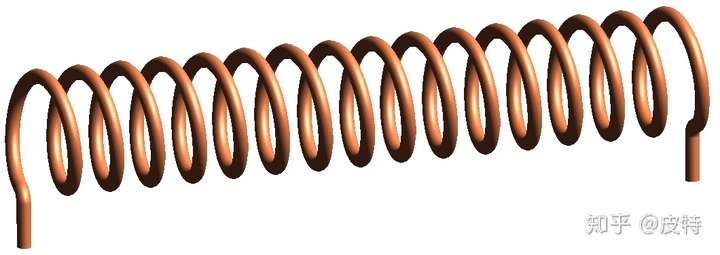
The simplest inductance is a spiral tube coil:
Situation during power-up
We intercept a small section of the spiral tube and we can see two coils, coil A and coil B:
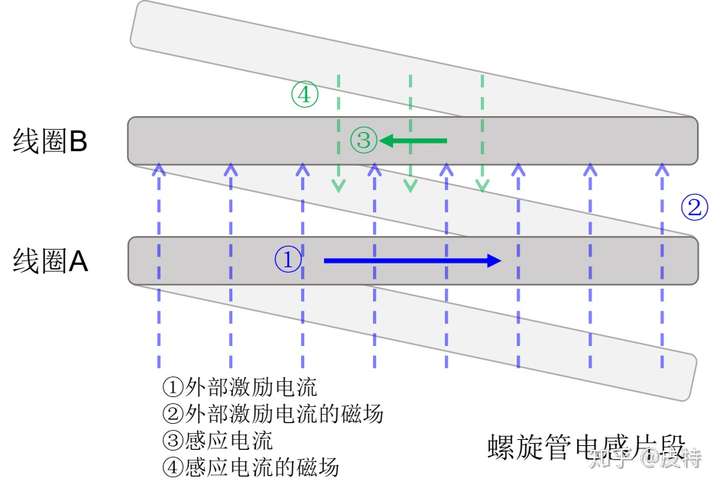
During the power-on process, the situation is as follows:
- The current passing through the coil A, assuming its direction as shown by the blue solid line, is called the external excitation current;
- According to the principle of electromagnetism, the external excitation current generates a magnetic field, and the magnetic field begins to spread in the surrounding space and covers the coil B, which is equivalent to the coil B cutting the magnetic lines of force, as shown by the blue dotted line;
- According to the principle of magnetoelectricity, the induced current is generated on the coil B, the direction is shown by the solid green line, and the direction is opposite to the external excitation current;
- According to Lenz's law, the magnetic field generated by the induced current is to oppose the magnetic field of the external excitation current, so it is shown as the green dotted line;
After the power is stabilized (DC)
After the energization is stable, the external excitation current of coil A is constant, and the magnetic field generated by it is also constant. The magnetic field and coil B do not move relative to each other, so there is no magnetization and no current represented by the solid green line. At this time, the inductance is equivalent to a short circuit for external excitation.
Third, the characteristics of inductance-the current cannot be sudden
After understanding how the inductor works, let's look at the most important characteristic of the inductor-the current on the inductor cannot change suddenly.
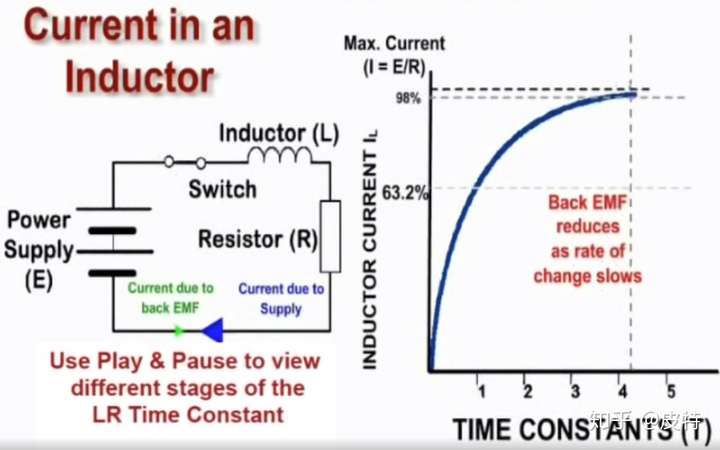
In the figure, the abscissa of the right curve is time, and the ordinate is the current on the inductor. Take the moment when the switch is closed as the time origin.
can be seen:
- At the moment when the switch is closed, the current on the inductor is 0A, which is equivalent to an open circuit. This is because the instantaneous current changes sharply and a huge induced current (green) will be generated to resist the external excitation current (blue);
- In the process of reaching a steady state, the current on the inductor changes exponentially;
- After reaching the steady state, the current on the inductor is I=E/R, which is equivalent to a short circuit of the inductor;
- Echoing the induced current is the induced electromotive force. Its function is to oppose E, so it is called Back EMF (back electromotive force);
4. What is inductance?
Inductance is used to describe the ability of a device to resist changes in current. If the ability to resist changes in current is stronger, the greater the inductance, and vice versa.
For DC excitation, the final inductance appears as a short circuit (voltage is 0).But in the process of energizing, the voltage and current are not 0, which means that there is power. The process of accumulating this energy is charging. It stores this energy in the form of a magnetic field. When needed (such as external excitation cannot maintain a steady state)Current under) release energy.
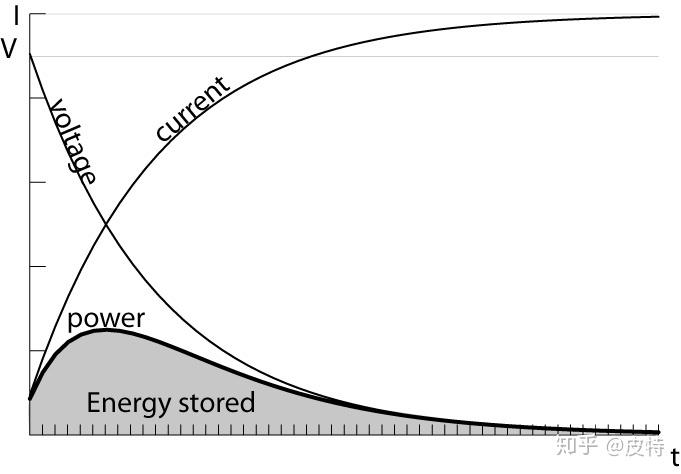
Inductance is an inertial device in the field of electromagnetics. Inertial devices don't like changes. Just like the flywheel in dynamics, it is difficult to turn at the beginning, and once it turns, it is difficult to stop, and energy conversion occurs during the period.